

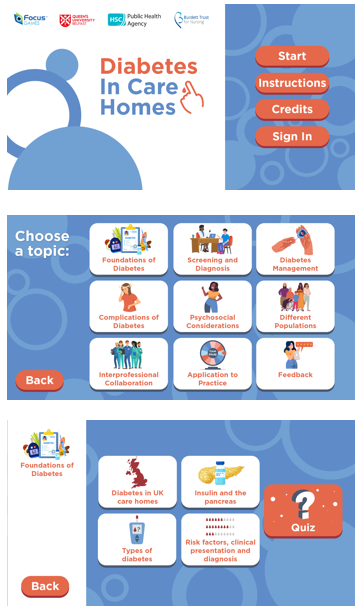
 Optimising Care Home Nursing Practice in Diabetes Care: Co-creation of a Digital Intervention
Professor Gary Mitchell, Queen’s University Belfast
HSC R&D Division Opportunity-Led Research Award (COM/5755/23)
Background: Diabetes management in care homes presents significant clinical challenges, yet access to evidence-based education tailored to this setting remains limited. This study aimed to develop and evaluate a co-designed digital educational intervention to improve staff knowledge and self-efficacy in diabetes care.
Methods: A sequential, mixed-methods research programme incorporated a scoping review, a grounded theory study involving 20 staff across 17 care homes, and a modified Delphi study involving 50 participants. Findings informed an accelerated experience-based co-design process involving 16 stakeholders, including care home staff, diabetes specialists and people with lived experience. The resulting digital educational intervention incorporated evidence-based content, interactive learning activities and clinically relevant scenarios. Evaluation involved 75 care home staff in Northern Ireland and 161 first-year undergraduate nursing students at Queen’s University Belfast. Qualitative interviews with 15 nurses further explored acceptability and perceived changes in practice.
Results: The scoping review identified 10 studies and highlighted gaps in diabetes education provision. Grounded theory analysis identified three interrelated categories: Prioritisation, Risk and Labour, underpinned by a core category of Misalignment between the complexity of residents' diabetes care needs and existing educational and organisational supports. The Delphi study established educational priorities relating to symptom recognition, glucose monitoring, diabetes-related complications and communication to support timely clinical escalation.
Care Home Staff Evaluation: Of 83 participants, 75 provided matched pre- and post-intervention data. Mean diabetes knowledge scores increased from 16.11 to 20.80 out of 23 (p<0.001; Cohen's d=1.71), representing a large effect. Significant improvements were observed in general diabetes knowledge (d=1.50) and insulin-related knowledge (d=1.12). Mean self-efficacy scores increased from 74.29 to 86.76 (p<0.001; d=0.77). Participants reported favourable learning experiences (mean scores >4/5) and engagement (15.57/20). Reflexive thematic analysis of 15 nurse interviews generated three themes: Learning That Fits, From Confidence to Action and Making Learning Possible. Nurses valued clinically relevant scenarios, interactive learning and flexible access. They described moving beyond reactive glucose monitoring towards preventative care and recognition of longer-term complications. Participants reported greater confidence discussing medication reviews and resident management with medical colleagues, alongside examples of diabetes-focused handovers and knowledge sharing with care assistants. However, protected learning time and managerial support varied, with some nurses completing education outside working hours. These findings suggest perceived changes in professional practice, although clinical behaviours were not independently verified.
Pre-Registration Nursing Evaluation: Of 174 participating students, 161 provided matched data. Mean diabetes knowledge scores increased from 8.89 to 18.36 out of 23 (p<0.001; d=1.59). Mean self-efficacy scores increased from 79.80 to 97.55 (p<0.001; d=1.15), demonstrating large effects across both outcomes.
Conclusion: This study demonstrated the potential of co-designed digital education to improve diabetes knowledge and self-efficacy among care home staff and undergraduate nursing students. The freely accessible resource provides a scalable educational intervention for workforce development. Further longitudinal evaluation is required to establish sustained improvements in clinical practice and resident outcomes.
Access the resource here: Diabetes in Care Homes