

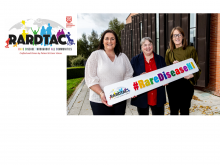
Rare Disease Day is on Saturday 28 February 2026. To celebrate this day, Amy Jayne (AJ) McKnight, Professor of Molecular Epidemiology and Public Health; Director of Postgraduate Research, School of Medicine, Dentistry, and Biomedical Sciences is raising awareness of rare disease and the need for equitable access to rare disease diagnostic opportunities, emerging therapies, and investment in bioresources linked to UK-wide national population-based registries.
Professor Amy Jayne (AJ) McKnight is a long-standing leader in rare disease research and within the rare disease community. Rare disease affects one in every 17 people, and there are over 114,000 people across Northern Ireland living with a rare disease.
AJ has been involved in rare disease research throughout her life both as a researcher and a participant. Research has given AJ an opportunity to explore why some people develop health conditions while others are protected.
As a researcher, she holds several roles including co-leading government advisory groups on rare conditions and leading the developing Northern Ireland rare disease and congenital anomaly registry.
She is also Co-Lead of the LifeArc Centre for the Acceleration of Rare Disease Trials, which is helping to speed up the delivery of clinical trials, increase the number of opportunities for patients with rare diseases to take part in research, and enable more rapid approval of new therapies for use in the National Health Service (NHS).
AJ and her team are passionate about improving the lives of people living with diseases by identifying new diagnoses, understanding more about biological markers of disease, and developing resources to help people live as well as possible for as long as possible.
Some of the research conducted by the team includes:
- communication needs for rare diseases (including rare cancers);
- developed digital infrastructure to support rare disease diagnosis and care;
- developed educational toolkits for healthcare professionals;
- informed rare disease policy in multiple countries.
As a research participant, AJ has lived experience of rare disease - her immediate family has lots of different rare diseases, most of which have complex health needs. This has helped her create meaningful engagement with the rare disease community as a cornerstone of her research. She believes people living with rare conditions, families, clinicians, researchers, and community organisations all contribute as active partners throughout the entire research journey from initial concept to dissemination of results.
It is from experience, understanding and knowing this community that AJ is an advocate and champion for rare disease:
“I genuinely want to perform inclusive research that helps answer questions and unmet needs in our local community as well as investigating broader research questions.”
“We need to shine a light on the isolation, the difficulties accessing diagnosis, care, education, employment, and the day-day impact of living with a rare disease. It’s only through information from courageous advocates who share their stories that we can make a real difference together.”
Health and Social Care Research & Development (HSC R&D) supports the rare disease community and has provided high-quality, engaging Personal and Public Involvement and Engagement (PPIE) training to all LifeArc DTP PhD students and to local stakeholders across NI, enriching the rare disease landscape further. HSC R&D is also involved in a rare disease network in NI.
Highlighting HSC R&D involvement in the rare disease community, Dr Claire Cleland, Senior Programme Manager, HSC R&D, said:
“Our involvement in establishing the Rare Disease Clinical & Academic Network with the research teams at Queen’s University Belfast and Ulster University, will help drive innovation and change in the rare disease research landscape, as the network brings together clinicians and academics to share their research and build collaborative partnerships benefiting those living with rare diseases.”
Work in this area continues. For AJ, there are still so many unanswered questions for rare disease research and she is calling for more sustained investment across the UK as rare diseases are often drivers of healthcare innovation and improvement:
“I think rare disease is often hidden in health and social care systems. Rare diseases are unrecognised and misunderstood by health, care, and education professionals when in reality they are often complex, multifaceted, lifelong challenges for individuals, families, and communities affected.
“We need equitable access to rare disease diagnostic opportunities, to emerging therapies, and investment in bioresources linked to UK-wide national population-based registries. We now have UK rare disease framework and action plans.
We are keen to have explicit legislative requirements to collect rare disease data across devolved nations and adequately funded rare disease registries across the UK and Ireland.”
For more information on Rare Disease in Northern Ireland please visit:
QUB rare disease team website:
https://www.qub.ac.uk/sites/RareDisease/
RARDTAC: supporting rare disease throughout all communities #RareDiseaseNI
LifeArc Centre for the acceleration of rare disease trials:
Homepage - Acceleration of Rare Disease Trials
Online resource to support carers of people with a rare disease:
Or email: raredisease@qub.ac.uk