

The Northern Ireland Ambulance Service Health and Social Care Trust (NIAS) provides high quality emergency and urgent care services throughout Northern Ireland (NI). Serving a population of nearly 2 million people, there are 46 stations and deployment points across NI.
NIAS has become increasingly research active as a Health and Social Care (HSC) Trust in recent years. Its research journey began in 2017/18, when Ciaran McKenna, the then Transformation Lead, brought together a group of NIAS staff who had a shared interest in developing research activity within the organisation. Under his leadership and with support from the Health and Social Care Research and Development (HSC R&D) Division, Public Health Agency, in 2019, the Southern Health and Social Care Trust (SHSCT) Research Office began overseeing governance approvals for all NIAS research studies, while also providing support and guidance to staff.
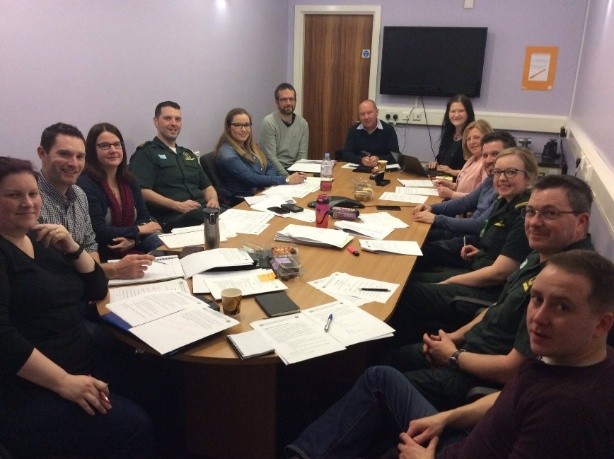
Picture: One of the early meetings of the NIAS staff group who had an interest in developing research activity, with Professor Julia Williams from the Royal College of Paramedics. November 2017.
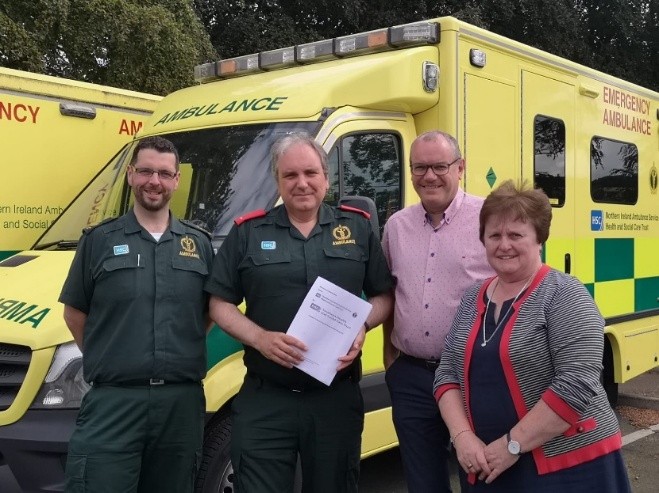
Picture: A Memorandum of Understanding between NIAS and the SHSCT was signed in July 2019 to formalise the collaboration. (L-R) Ciaran McKenna, (Assistant Director of Operations); Dr Nigel Ruddell (NIAS Medical Director); Dr Peter Sharpe (former SHSCT Research Director) and Irene Knox, (former SHSCT Research Manager).
Momentum was building, but there was a workforce gap that needed to be filled to enable NIAS to build research capacity. HSC R&D agreed to provide funding to address this need and the first NIAS R&D Manager was employed.
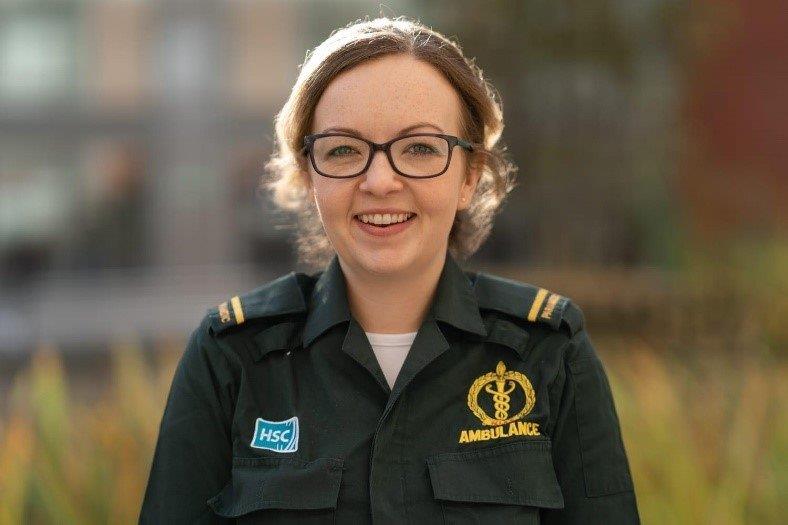
Julia Wolfe took up this post in February 2022 and started to establish a culture of research. Julia has been in ambulance service for 15 years having worked in a frontline operational role, within the Community Resuscitation Team, as an Infection Prevention and Control Practitioner and then as the R&D Manager during that time.
Julia’s R&D role enables NIAS to have a dedicated staff member with protected time to drive and develop research capacity across the organisation. With a discretionary budget provided by HSC R&D, NIAS staff have also been supported to present data and research findings at conferences and represent and champion NIAS research.
Julia highlighted the significant benefits of NIAS becoming increasingly research-active in recent years, noting the distinctive contribution the ambulance service can make to health research. Julia explained: “NIAS is one of six Health and Social Care Trusts in Northern Ireland, and as the only regional trust, we’re in a unique position as any exploration into NIAS-related data gives insights into the whole NI population in terms of the out of hospital environment.”
“Historically, ambulance services were seen as transport providers. But we have moved on from this and are now clinical, research-active, person-centred organisations that play a vital role in the wider healthcare system.”
Under the direction of Neil Sinclair (Chief Paramedic Officer and Director of Research) and with Julia at the helm, NIAS has made big strides these past four years. In 2022, NIAS developed its first NIAS R&D strategy and established the R&D Oversight Group, a governance and assurance group. In 2023, NIAS secured grant funding to employ their first research paramedic and set up the first personal and public involvement (PPI) group, ensuring that members of the public and service users are involved in the delivery of the research strategy. In 2024, further funding was secured to employ a second research paramedic.
The ambulance service has participated in a variety of studies over the last few years, including many national studies. For NIAS, these have mostly been studies involving staff or utilising anonymised datasets, such as CATNAPs
CATNAPS: Fighting fatigue in the NHS ambulance workforce | ARC East of England
and the POHCA study.
Julia explains: “On a local level, we have also conducted our own studies, such as the Pathways study, which was the first NIAS-sponsored study we started in 2022.”
Bloomer, K., Scott, J., Smyth, R., & Wolfe, J. (2024). Paramedic perceptions of barriers and facilitators to the use of ambulance service appropriate care-referral pathways in Northern Ireland: a qualitative study. British Paramedic Journal, 9(3), 13–20. https://doi.org/10.29045/14784726.2024.12.9.3.13]
“We have undertaken an out of hospital cardiac arrest baseline study, which has been carried out in collaboration with Queen’s University Belfast (QUB) and funded by NI Chest Heart and Stroke. We’ve also completed two Marie Curie funded studies, one with QUB and one with Ulster University, exploring end of life care provision in Northern Ireland.”
Research-active healthcare organisations tend to achieve better outcomes for patients, such as lower mortality and improved survival rates. They tend to provide an enhanced quality of care which leads to improved patient experiences. Organisations that are research-active have been reported to have higher levels of staff retention and job satisfaction. On an organisational level, evidence shows they perform better when compared to other services or Trusts that aren’t active in research.
Ambulance services face a number of challenges when working to become research‑active. Securing funding to protect the time of clinical staff is often difficult, making it hard for paramedics and other frontline colleagues to participate in studies or develop their own research. In addition, building and sustaining research workforce capacity can be challenging, particularly during periods of high operational demand, when maintaining service delivery understandably becomes the priority.
It has been rewarding watching NIAS grow and they have achieved a great deal in a short space of time, successfully contributing to the NI research ecosystem.
They have been grateful for opportunities to share their findings and present at conferences and events. In 2024, Emma McCorkell, the first research paramedic was awarded a Rising Star award at the Advancing Healthcare Awards NI.
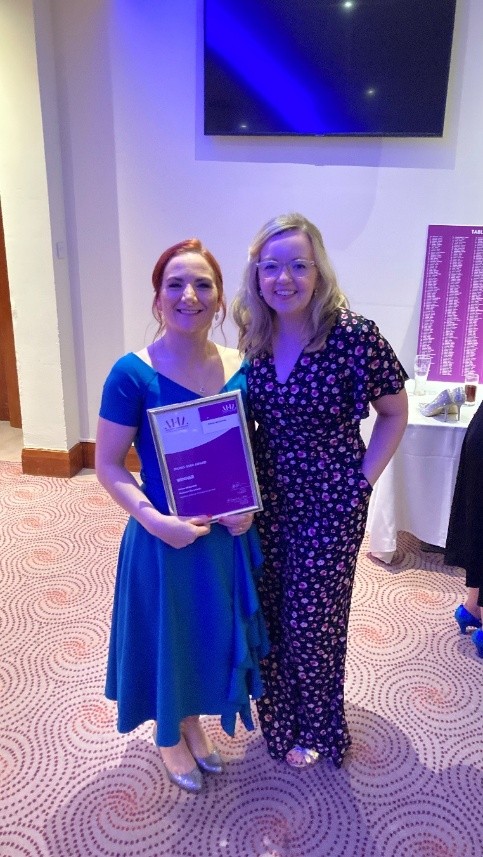
Picture: Emma McCorkell and Julia Wolfe at the Advancing Healthcare Awards NI 2024.
In the same year, Paul Corns was awarded the prize for best Rapid 5 presentation at the NI Allied Health Professional Research and Innovation conference.
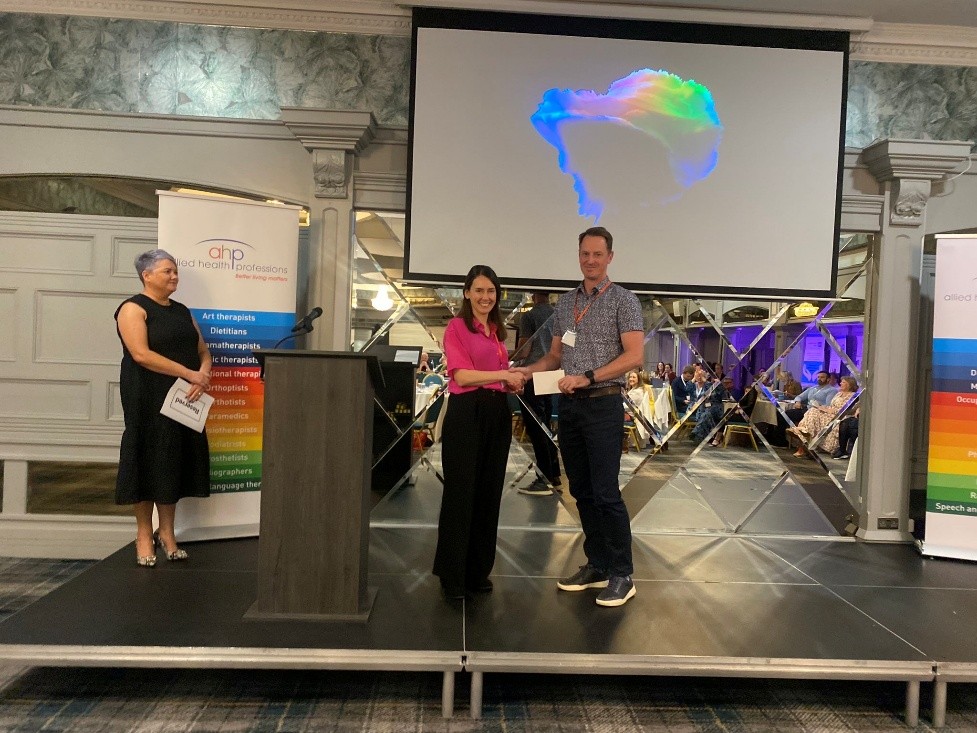
And NIAS has reached further afield in presenting their research. Julia said:
“On a national level, we’ve been able to attend and present our research at the Royal College of Paramedics Research and National conferences and the 999 Emergency Medical Services (EMS) Research Forum. We’ve also been able to present to international audiences at the European Resuscitation Council Congress in 2024 and 2025, as well as supporting our colleagues in the Helicopter Emergency Service (HEMS) to present their results at the Oslo HEMS conference.”
Finally, what are the future plans for NIAS research?
“We have a second out of hospital cardiac arrest study funded by NI Chest Heart and Stroke and we will continue to undertake good quality research, generating new knowledge to improve patient care. We would love to get involved in recruiting patients into our first clinical trial in the next few years …a space to watch for in the future of ambulance research in Northern Ireland.”
Contact details
To contact the NIAS Research Office, email Research@nias.hscni.net
For more information:
- Visit the HSC R&D website: HSC Trust Research Offices | Public Health Agency - Research & Development in Northern Ireland
- Visit the National Ambulance Research Steering Group (NARSG) website: Northern Ireland Ambulance Service